
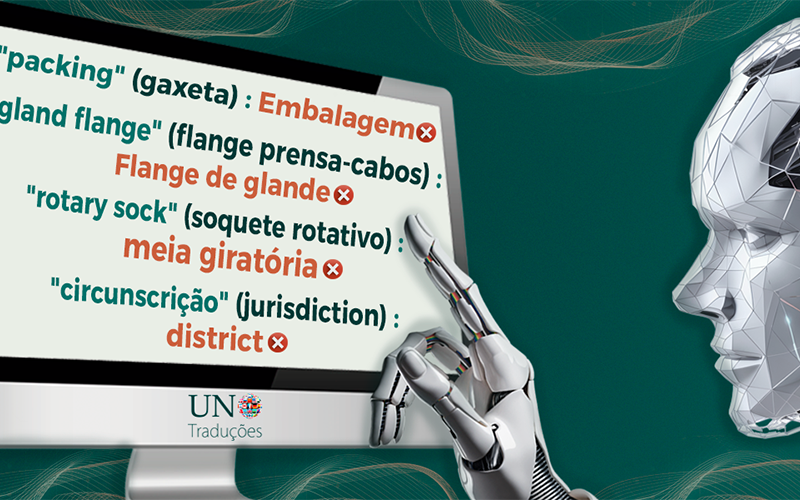
The evolution of artificial intelligence (AI) technologies has brought significant gains in speed and accessibility to translation processes. However, when applied to corporate contexts — especially in technical texts, operational manuals and regulatory documents — AI translation still has critical limitations that can compromise not only the quality of communication, but also the safety and efficiency of business operations.
One of the main challenges is terminological precision. In technical environments, each term has a specific meaning, often different from the common use of the word. AI systems tend to select translations based on statistical frequency, and not necessarily on contextual appropriateness. This can lead to serious errors, such as the incorrect translation of mechanical components or regulatory concepts, generating erroneous and potentially dangerous instructions. In technical manuals, for example, a simple failure to translate parts or commands can compromise the functioning of equipment and cause major operational failures.
Another sensitive point is the terminology inconsistency. Unlike structured processes with glossaries and translation memories, AI tools can vary the translation of the same term throughout the document. This type of inconsistency is particularly problematic in areas such as engineering, legal and intellectual property, where uniformity is essential to ensure clarity and technical or legal validity. Studies indicate that terminology-related errors account for the largest share of critical errors in AI translations, reinforcing the risk in highly complex contents.
The lack of contextual and cultural suitability is also a significant limitation. Although current systems are capable of generating fluent texts, they still have difficulties interpreting nuances, ambiguities and context-specific references. This results in literal, inadequate or even distorted translations, especially in corporate environments that require accuracy of tone and alignment with the local culture (Localization). In institutional or marketing materials, this type of failure can directly impact the brand perception and jeopardize the overall communication.
There is also the risk of distortion or inappropriate addition of information. In scenarios where the template finds contextual gaps, the AI can “complete” the content with incorrect interpretations, or even with information that does not exist in the original text. This behavior, often imperceptible on a superficial reading, is particularly critical in technical, medical or regulatory documents, in which any change in meaning can have severe consequences.
The impact of these failures goes beyond linguistic quality. From an operational point of view, inaccurate translations can lead to execution errors, rework and increased costs. In industrial sectors, poorly translated instructions can result in the improper use of equipment, or in the non-compliance with safety regulations. In legal and contractual contexts, a single incorrect word can change the meaning of clauses, exposing companies to legal and financial risks.
Another relevant point is the impact on corporate governance and compliance. The free use of AI tools, without terminology control and clear guidelines, can lead to inconsistent communications among different markets and teams. This compromises the standardization of corporate language and can even result in violations of internal or regulatory policies.
Finally, it is important to consider the risks related to the General Data Protection Act (GDPA). The use of public translation platforms can expose sensitive and confidential information, since many systems use the data entered to train templates, which can conflict with data protection legislations and with information confidentiality and security policies.
Against this backdrop, AI translation (within the applicable legal, contractual and judicial standards and processes) should be seen as a support tool and not as a definitive solution. The combination of technology and expert human revision, together with the use of glossaries, translation memories and structured processes, is paramount to guarantee quality, consistency and security.
In an increasingly competitive global context, communicating accurately is not just a linguistic issue, but a strategic one. And, in this sense, the quality of translations can be the difference between operational efficiency and corporate risk.